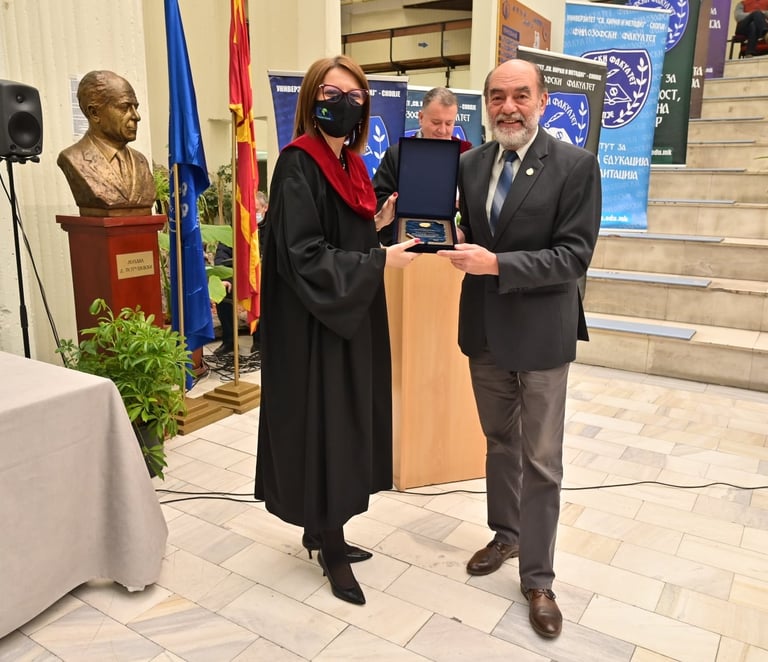
Professor Denko Skalovski
Professor Denko Skalovski is a highly distinguished Full Professor of Philosophy at the University “Ss. Cyril and Methodius” (UKIM), Faculty of Philosophy, in Skopje, North Macedonia. His career is defined by a rigorous interdisciplinary approach that synthesizes Critical Theory, the Ethics of Responsibility, and pioneering work in Philosophy of Gender and Cultural Critique. He holds a prominent position within the Institute of Philosophy and is recognized as a foundational figure in the establishment of the Institute of Gender Studies at UKIM. Furthermore, Professor Skalovski is deeply engaged in applied ethics, serving as the Vice President of the Center for Integrative Bioethics at the Faculty of Philosophy.
His core research domains are exceptionally broad yet unified by a focus on contemporary social crises and the imperative for ethical renewal. These areas include the Philosophy of Culture, Aesthetics (Philosophy of Art), Philosophy of Gender, and the application of Ethics of Responsibility to global issues, bioethics, and post-communist transformation. His academic authority is underpinned by significant international affiliations, notably postdoctoral research conducted at the Johann Wolfgang Goethe University in Frankfurt am Main, Germany, under the supervision of Professor Axel Honneth. This institutional connection firmly establishes his work within the lineage of the Frankfurt School of Critical Theory.
Professor Skalovski’s philosophical work is uniquely complemented by a robust commitment to public life and political ecology. He is a prominent public intellectual in North Macedonia, integrating his theoretical commitments with practical political service as a long-standing environmental activist and former Vice President of the Green Party (DOM). This biographical narrative aims to establish Professor Skalovski as an international authority in theoretical and applied philosophy, emphasizing the unique convergence of his expertise in post-Marxist critique, ecological ethics, and gender studies.

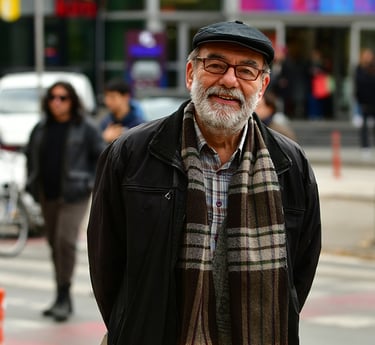
I. Academic Foundations and Early Career (1956–1999): The Genesis of Ethical Commitment
A. Early Life, Education, and the Turn to Philosophy (1956–1981)
Denko Skalovski was born on November 20, 1956, in Skopje, North Macedonia. His academic journey began with a distinctive focus on the arts, as he initially studied Theatre Directing in Belgrade, demonstrating an early engagement with expressive forms. This foundational interest in artistic media and representation would later inform his specialization in Aesthetics and the analysis of cultural forms.
He subsequently pivoted his academic focus toward philosophy, completing his initial studies in Belgrade before graduating in Philosophy from the Faculty of Philosophy in Skopje in 1981. This transition marked the start of his engagement with the critical theoretical frameworks necessary for analyzing cultural and social structures.
B. Defining the Ethics of Responsibility (1989–1992)
A pivotal period in Professor Skalovski's life occurred around the turn of the 1990s, where his philosophical interests converged decisively with socio-political action. His public engagement began actively in 1989, when he became a noted activist in the Macedonian Ecological Movement. This early involvement in addressing environmental degradation was not merely tangential but became the practical impetus for his deepest theoretical work.
This activism found its rigorous theoretical grounding in 1992, when he completed his Master’s thesis at the Faculty of Philosophy in Skopje, dedicated to The Ethics of Responsibility of Hans Jonas. The decision to focus on Jonas's work is critical, as the Principle of Responsibility provides an ecological and moral imperative demanding that contemporary technological decisions prioritize the survival of the human species in the face of modern hazards. This commitment establishes that Professor Skalovski's philosophy is fundamentally a Philosophy of Praxis, driven by a search for philosophical justification and structural guidance for his pre-existing environmental and moral commitments, a theme that has continued to dominate his publications in bioethics and global crisis theory.
C. Doctoral Research: Aesthetics and Critique (2000)
Professor Skalovski achieved a major academic milestone in 2000, earning his Doctoral Degree in Philosophy. His dissertation, Antipodes of the Contemporary Philosophy of Music, placed his expertise in Aesthetics (Philosophy of Art) within a contemporary critical context. This focus completed the intellectual circle started with his theatre studies, emphasizing the critical analysis of cultural expression.
In the same year, 2000, he was elected Assistant Professor at UKIM, marking the formal beginning of his professorial career.
II. Professorial Ranks and Institutional Leadership (2000–2010): Establishing Interdisciplinary Centers
The period between 2000 and 2010 saw Professor Skalovski’s advancement to the highest academic rank and his critical role in founding institutions that reshaped the academic landscape of North Macedonia.
A. Academic Ascent and Cultural Interpretation (2000–2010)
Professor Skalovski’s rapid ascent through the academic ranks culminated in his election as Full Professor in 2010. This promotion recognized his sustained contribution to research and teaching across his diverse fields of specialization.
During this decade, he also took on the significant role of interpreting national cultural history. In 2003, he co-authored the biography, Todor Skalovski - the Life and Work. This scholarly dedication to the life of Todor Skalovski, the celebrated Macedonian composer and conductor responsible for the national anthem, "Denes nad Makedonija" , demonstrates the application of his expertise in the philosophy of art and cultural history to a figure of major national significance, significantly broadening his profile beyond purely theoretical philosophy.
B. Founding the Institute of Gender Studies (2005)
Professor Skalovski’s most significant contribution to the broader social science landscape of the region came in 2005, when he was a crucial team member, alongside Dean Trajan Gocevski and others, in the foundation of the Institute of Gender Studies at the Faculty of Philosophy, UKIM. This institute was a pioneering achievement, recognized as the first of its kind in North Macedonia and the Balkans, and was specifically noted in European Commission reports as evidence of social progress.
His enduring affiliation with the Institute is fundamental to his current academic identity. He is a core instructor, teaching specialized interdisciplinary courses such as Gender and Philosophy, Gender and Sport, History of Gender in the Renaissance and the Enlightenment, and Multiculturalism and Gender. By co-founding this institute, Professor Skalovski successfully transitioned his early focus on the Philosophy of Culture (Aesthetics/Music) toward critical social analysis, fulfilling a crucial mandate of Critical Theory by analyzing issues of identity, power, and social reification in contemporary society. His courses linking Gender with the Sociology of Sport represent a unique and impactful specialization.
III. Global Critique, Thematic Consolidation, and Public Intellectualism (2010–Present)
A. Anchoring in Critical Theory: The Frankfurt School Affiliation (2010 & 2015)
A defining feature of Professor Skalovski’s career since 2010 is his profound and sustained relationship with the intellectual center of Critical Theory. He conducted two extensive periods of advanced postdoctoral research at the prestigious Johann Wolfgang Goethe University in Frankfurt am Main, Germany, first in 2010 and again in 2015.
Both periods of research were overseen by Professor Axel Honneth , the influential figure who led the Institute for Social Research. This affiliation is paramount, securing Professor Skalovski’s intellectual position within the respected lineage of the Frankfurt School and establishing a sustained commitment, confirmed by his listing as a permanent associate of the Institute of Philosophy at the University of Frankfurt since 2010.
His theoretical output reflects this commitment, notably in the June 2015 publication, Kosík's Dialectics of Concrete Totality. This paper directly uses the framework of Critical Theory to analyze concepts like totality, reification, and praxis, citing Habermas and Honneth. This methodological anchoring provides the necessary framework for his critique of the "economic logic of profit/capitalism" and the crises resulting from the "infinity" of unrestrained progress.
B. Ethics, Bioethics, and Planetary Responsibility (2023–2024)
Professor Skalovski’s lifelong commitment to Ethics of Responsibility (established in 1992) has found institutional expression in his role as Vice President of the Center for Integrative Bioethics. His work explicitly engages in the high-level debates defining the field, such as in his paper BIOETICS AND ITS OPPONENTS: HANS JONAS VERSUS KARL-OTTO APEL AND JÜRGEN HABERMAS , where he defends Jonas’s fundamental ecological imperative against competing contemporary moral philosophies.
Recent publications underscore the application of this framework to global crises. The co-authored article, Responsibility in the Time of Crisis (June 2023), analyzes the end of the "western" value system and calls for a "new universalist moral optimism" and the construction of new social systems based on "macro ethics". The research keywords—crises, bioethics, responsibility, and evolution —confirm this focus on applying ethics to large-scale, existential threats.
This thematic arc culminated in the anticipated December 2024 publication of THEODOSIUS DOBZHANSKY AND THE EVOLUTION OF HUMANITY: A DIFFERENT APPROACH. In this work, Professor Skalovski examines the complex dialectical relationship between biological evolution and human cultural intervention, asserting that evolution is ongoing and interdependent with human action. He argues that humanity, through its appearance and choices, has asserted itself as the main factor responsible for the survival of the species and the preservation of planetary biodiversity—a concept directly derived from the existential demands of the Ethics of Responsibility.
C. Public Service and Applied Philosophy (2013–Present)
Professor Skalovski’s career is distinguished by the direct application of his theoretical principles to civic and political life. This continuum began with his ecological activism in 1989 and resulted in high-profile leadership roles later in his career.
In 2013, he was elected Vice President of the Green Party of Macedonia (DOM). In the same year, he was elected as a Council Member in the Council of the City of Skopje. This continuous engagement ensures that his theoretical commitments are tested and refined through practical governance.
His academic writing often addresses issues relevant to his civic role, notably the paper Creating Urban Europe: Problems of Definition (Conspectus-thesis). This work, which focuses on the philosophical and axiological difficulties in defining European borders, demonstrates how his academic expertise on cultural typology translates directly into analysis of urban security and policy dilemmas. Professor Skalovski is recognized as a Leading Public Intellectual in North Macedonia, successfully bridging continental philosophy, ecological policy, and critical urban studies, demonstrating the practical force of philosophy in action.